
HOW INTELLIGENT SYSTEMS SUPPORT THE NERVOUS SYSTEM
.jpg)
Technology has long been synonymous with speed.
Faster communication.
Instant access.
Constant updates.
These advances have reshaped how we live and work in remarkable ways. But they have also quietly reshaped how the body moves through the world.
The nervous system, which evolved for intermittent signals and long periods of rest, now operates in an environment of near-continuous input.
The result is not always obvious stress.
More often, it is a subtle state of persistent alertness.
The body remains ready.
Attention stays slightly elevated.
Even during moments meant for rest, the nervous system rarely fully disengages.
This state is functional.
But it is costly.

Lounge Area, Paradiso - The Genesis Collection, Riviera Maya, Mexico.
Research across neuroscience and human computer interaction increasingly shows that technology itself is not inherently harmful. The issue lies in how it interacts with human biology.
Most digital systems are designed to demand engagement. Notifications appear suddenly. Screens shift abruptly. Prompts request immediate response. Each interaction feels small in isolation, but together they create a steady pattern of interruption.
Over time, this trains the nervous system to expect disturbance.
Calm becomes something that must be forced rather than something that naturally arises.
A growing body of design research suggests there is another approach.
Instead of demanding attention, supportive technology removes the need for it.
Instead of accelerating experience, it smooths it.
Instead of adding constant choice, it quietly resolves decisions in the background.
Studies on cognitive and sensory load show that the brain expends significant energy simply managing transitions. Shifts in light, temperature, sound, and task require continuous adjustment. When these changes are abrupt or require conscious input, fatigue accumulates.
When they are gradual and automatic, the nervous system relaxes.
The most supportive technologies are often the least noticeable.
They operate quietly, adjusting in response to context rather than command.
Light that follows the natural progression of the day rather than switching suddenly.
Temperature that shifts slowly, mirroring outdoor rhythms instead of fighting them.
Sound environments that soften as activity winds down.
The body responds to this continuity almost immediately.
Gradual change signals safety.
Abrupt change signals interruption.
This distinction is fundamental to how the nervous system interprets its surroundings.
Research in circadian biology reinforces this idea. Systems that align with natural rhythms support hormonal balance, sleep quality, and emotional regulation. Systems that override rhythm, such as bright light late at night, constant indoor climates, and sudden alerts, disrupt these processes even when people feel accustomed to them.
Adaptation is not the same as alignment.
Another often overlooked element of calming design is reduction.
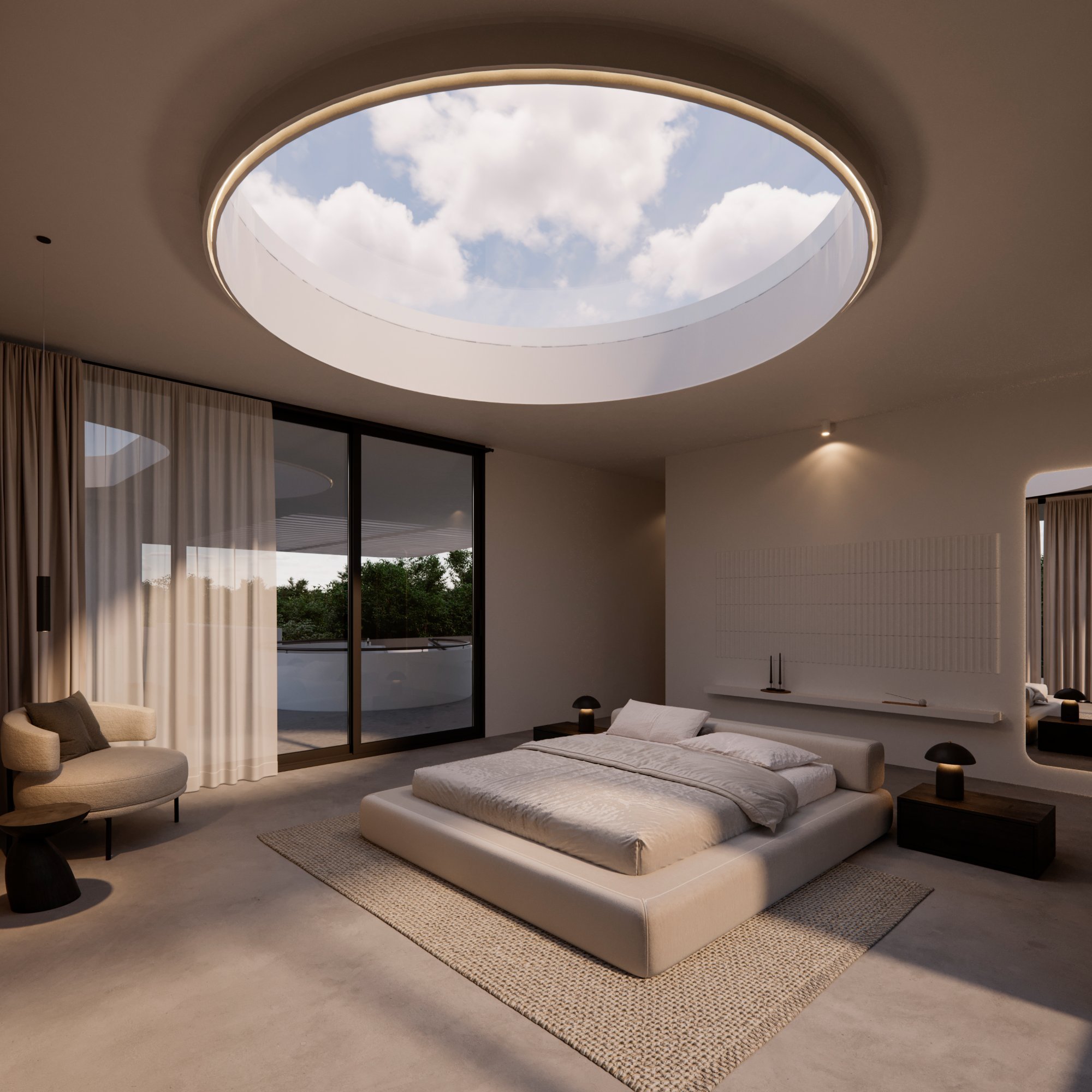
Bedroom, Los Arcos - The Genesis Collection, Riviera Maya, Mexico.
The most effective environments are not those that offer endless controls, but those that quietly remove unnecessary decisions. Decision fatigue is a well-documented phenomenon linked to stress, reduced self-regulation, and mental exhaustion.
When the environment no longer asks for constant adjustment, attention returns to what matters.
This is why spaces shaped by calming systems often feel simpler, even when they are technologically advanced. The complexity has not disappeared. It has been absorbed.
Importantly, calming technology does not eliminate stimulation.
It respects context.
It allows energy and activity when appropriate, and gently withdraws them when the body needs rest.
In this way, technology becomes less of a presence and more of a support.
People often describe these environments in intuitive ways.
They feel balanced.
More at ease.
Better rested.
Less irritable.
Focus deepens.
Sleep improves.
The changes are subtle, but consistent.
The nervous system thrives on rhythm, predictability, and gentle transitions. When systems are designed around these principles, technology stops competing with the body and begins cooperating with it.
This represents a quiet shift in how innovation is evolving.
The future is not louder.
Not faster.
Not more demanding.
It is calmer.
More responsive.
More human.
Technology that truly supports wellbeing does not announce itself.
It allows the body to forget it is there.
And in that forgetting, something important happens.
Attention returns to the present moment.
The nervous system softens.
And the space for real rest finally appears.
contact us