
WHAT THE MARKET IS WHISPERING: FIVE SIGNALS WORTH TRACKING IN JUNE 2026
Most market reports tell you what already happened. The more useful question is what is happening now that has not yet reached the headlines, and what it means for anyone deciding where to commit capital in this region over the next several years.
The Tulum market in 2026 is not the market of 2021. The years of uniform appreciation, when almost anything with a render and a reservation agreement sold within weeks, are over. What has replaced them is more interesting, and considerably more revealing about where durable value actually sits. The signals below are not predictions. They are measurable shifts, each one backed by data, each one pointing in the same direction.
01. The correction is real, and it is segmented
This is the signal everything else depends on, and most marketing in this region works hard to avoid stating it plainly.
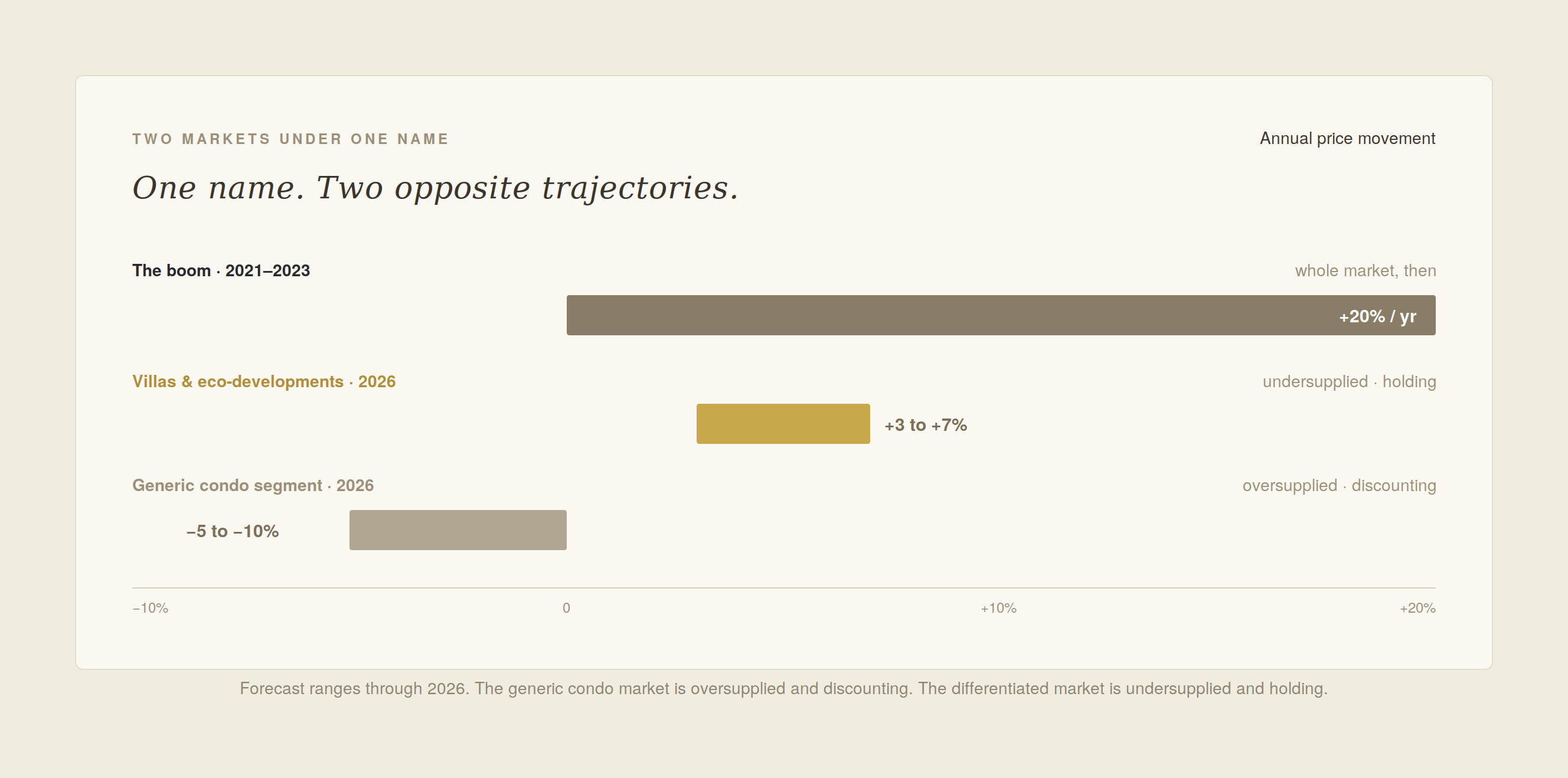
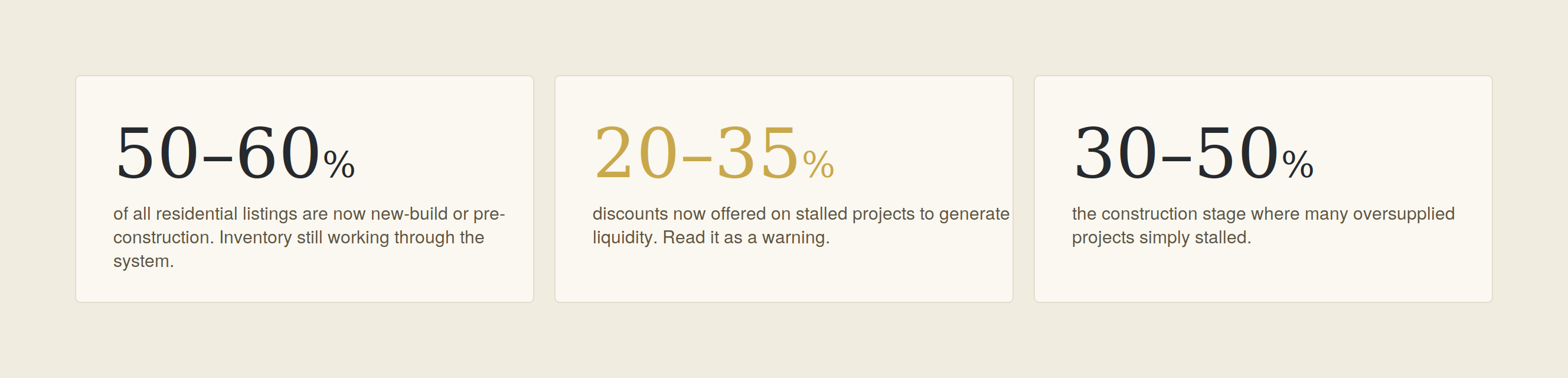
Tulum's broad residential market has corrected. After the 2021 to 2023 surge, when prices rose at roughly 20 percent annually, the market hit a structural problem: oversupply. Developers launched hundreds of projects simultaneously, almost all targeting the same buyer, the American or Canadian second-home purchaser in the 200,000 to 500,000 dollar range, with near-identical product in undifferentiated locations. When North American interest rates rose and discretionary investment slowed, that buyer segment contracted sharply. Projects stalled at 30 to 50 percent construction. Developers began offering discounts of 20 to 35 percent to generate liquidity. New-build and pre-construction product now represents an estimated 50 to 60 percent of all residential listings, which tells you how much inventory is still working through the system.
That is the headline number, and on its own it reads as a warning. But the correction has been highly uneven, and the unevenness is the actual signal.
Luxury villas and eco-developments have not corrected with the broader market. Forecasts for this segment project modest annual appreciation in the range of 3 to 7 percent through 2026, supported by limited supply and continued demand from high net worth buyers, while the condo segment was expected to stay flat or decline a further 5 to 10 percent before stabilising. Two markets are operating at once under a single name. The generic condo market is oversupplied and discounting. The genuinely differentiated luxury market is undersupplied and holding. A serious buyer now has to read both, and understand which one a given property actually belongs to.
02. Scarcity has replaced momentum as the thing that holds value
During the boom, the rising tide carried everything. That has stopped, and what the receding water has exposed is which assets had genuine scarcity behind them and which were simply riding the trend.
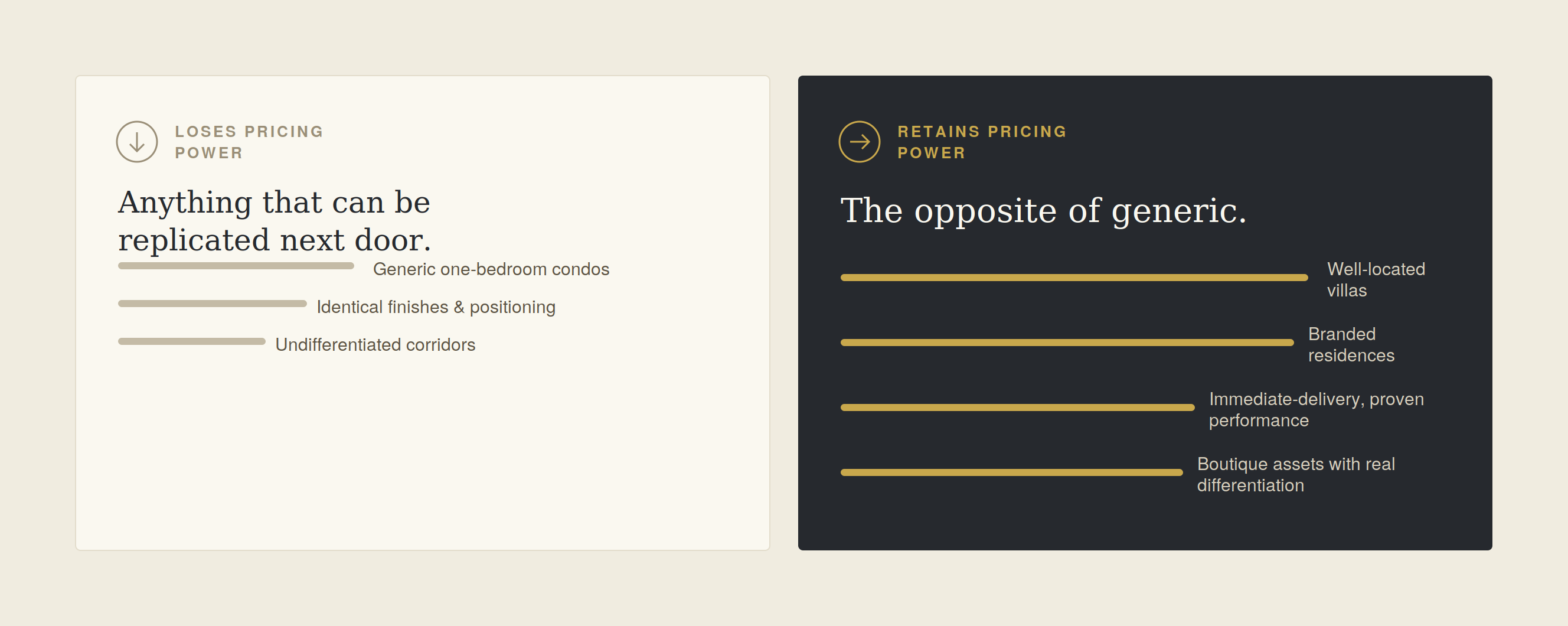
The mechanism is straightforward. A stylish one-bedroom condo is not competing against an abstract idea of Tulum demand. It is competing against the many other near-identical one-bedroom units in the same corridor, with similar finishes and similar rental positioning. Generic product of that kind has lost most of its pricing power. What retains pricing power is the opposite of generic: well-located villas, branded residences, immediate-delivery properties with demonstrated performance, and boutique assets with real differentiation. The market has stopped rewarding the fact of owning in Tulum and started rewarding the specifics of what exactly you own and where.
This is why aggressive discounting on incomplete projects should be read as a warning rather than an opportunity. A 25 percent reduction on a pre-completion asset signals one or more of the following: a developer cash flow crisis, a weak location that cannot command its price, the risk of specification downgrades as budgets get cut, or delivery uncertainty. Genuinely scarce, well-positioned locations do not need to discount that way, because the demand for them has not gone anywhere.
03. Infrastructure has moved from background to foreground, but it matures in waves
For the first time, the connectivity story in this region is real rather than promised, and that changes the underlying value equation for well-positioned property. It also requires honesty about how unevenly that maturation arrives.
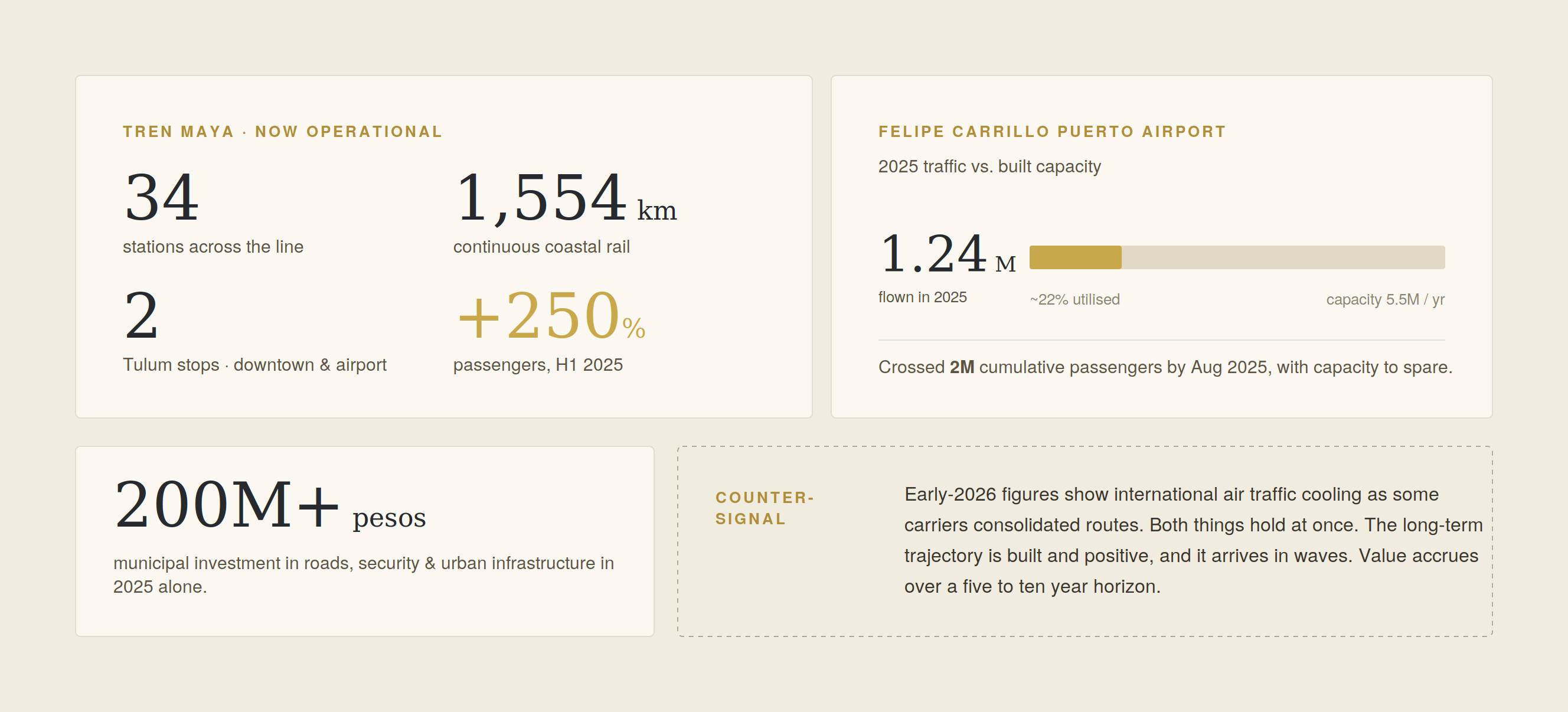
The Tren Maya now runs across 34 stations and 1,554 kilometres, with two stops serving Tulum, one downtown and one at the airport, placing the entire coast on a continuous rail line for the first time. Its passenger numbers jumped more than 250 percent in the first half of 2025. Tulum's Felipe Carrillo Puerto International Airport, which opened in December 2023, has been ramping up, crossing two million cumulative passengers by August 2025 and handling roughly 1.24 million in 2025 overall, against a built capacity of up to 5.5 million annually. The municipal government invested over 200 million pesos in roads, security, and urban infrastructure in 2025 alone.
The honest counter-signal sits right alongside this. Early 2026 figures show international air traffic cooling as some carriers consolidated routes. Both things are true at once. The long-term infrastructure trajectory is strongly positive and largely already built, but it arrives in waves rather than a straight line, and the airport's near-term route consolidation is a real data point a serious buyer should weigh rather than ignore. Infrastructure that is already constructed and operational is a different proposition from infrastructure that is promised, and the value it adds accrues to property positioned to benefit from it over a five to ten year horizon rather than overnight.
04. Due diligence has become architectural, because the climate enforces it
The most encouraging shift is in the sophistication of the questions buyers are now asking. Urgency has given way to genuine investigation, and the investigation has become technical.
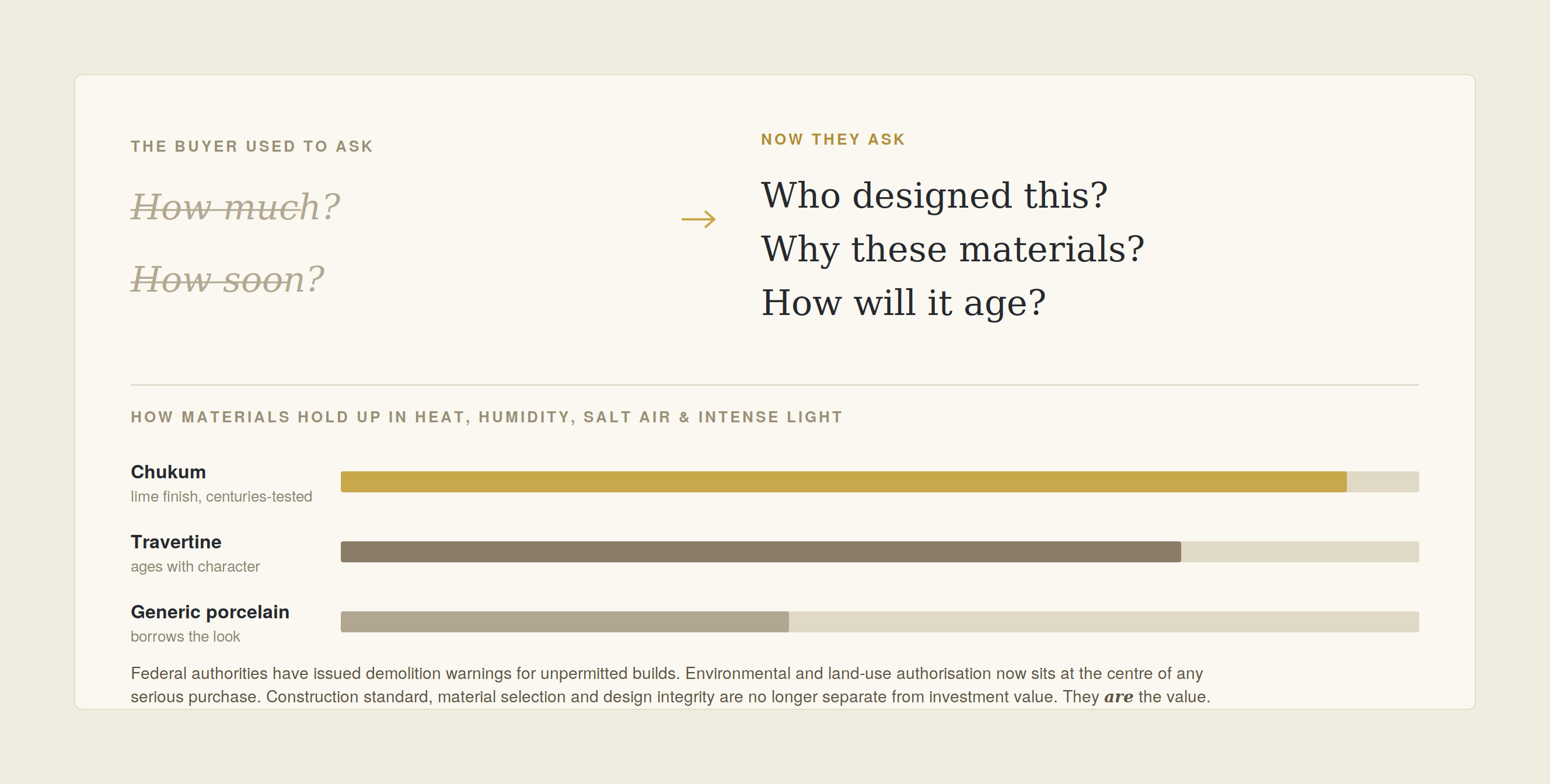
The questions have changed from how much and how soon to who designed this, why these materials, how will this age, does this building belong to its environment or merely borrow its look. This is not aesthetic fussiness. In this specific climate it is financial prudence, because the conditions here expose shortcuts within a few seasons. Heat, humidity, salt air, and intense light are unforgiving. A travertine floor ages differently from porcelain. Chukum, the lime-based finish used in this region for centuries, holds up precisely because it was developed for these conditions, and it records the quality of the hand that applied it. Construction standard, material selection, and design integrity are no longer separate from investment value. In a market that has stopped rising automatically, they have become the primary determinants of which assets hold and which decline.
The environmental dimension has teeth as well. Federal authorities have issued demolition warnings for unpermitted builds, which makes environmental and land-use authorisation a non-negotiable part of due diligence rather than a formality. The era in which a buyer could rely on the general assumption that Tulum always rises is over. What replaces it is discipline, and discipline rewards projects built with patience over those built on speed.
05. Community has become the asset that cannot be oversupplied
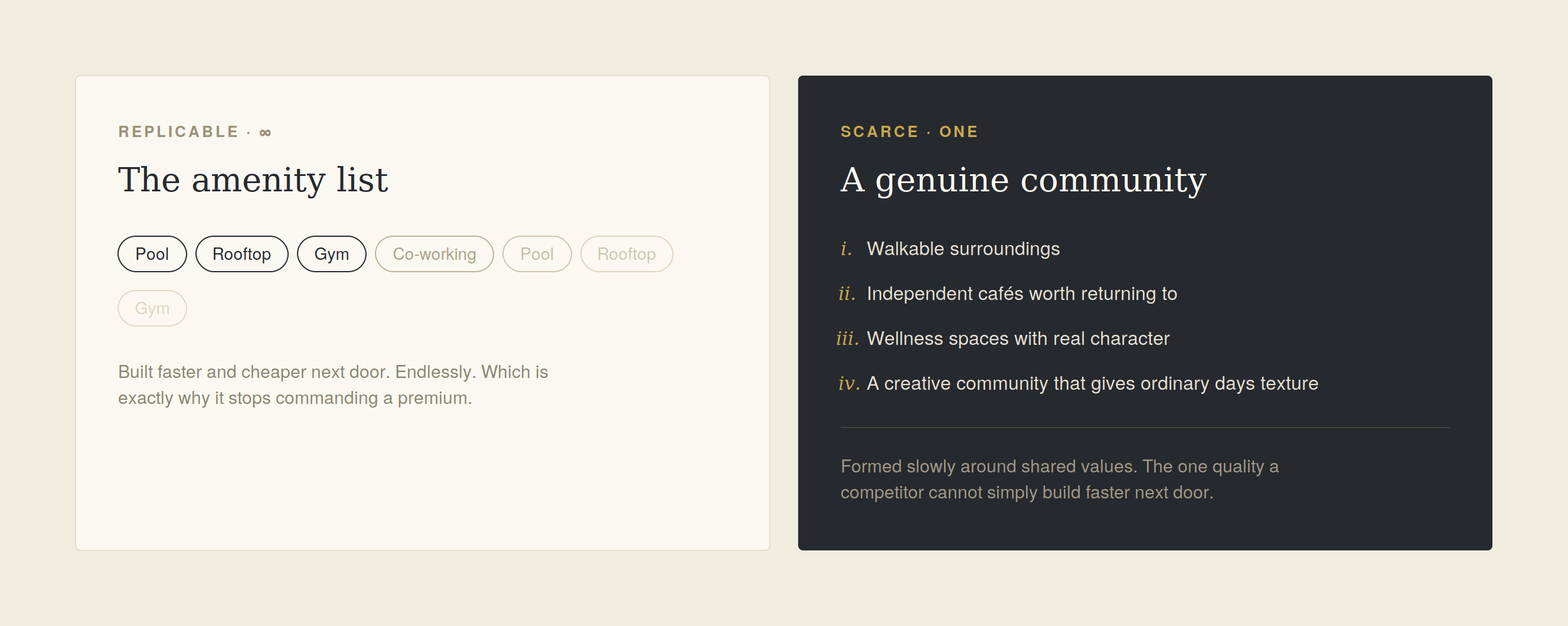
The final signal is the one that points furthest ahead. For years, developments competed by accumulating amenities. The pool, the rooftop, the gym, the co-working space. As the condo market demonstrated, amenities can be replicated endlessly, and anything that can be replicated endlessly loses its pricing power.
What cannot be replicated on demand is genuine community, and the market is beginning to price that distinction. Buyers are increasingly looking past the amenity list toward the harder question of what daily life actually consists of: walkable surroundings, independent cafés, wellness spaces with real character, restaurants worth returning to, and a creative community that gives ordinary days texture. Value is being defined more and more by what exists beyond the boundary of the property rather than only within it.
This is the deepest signal because it is the least reversible. Oversupply corrects. Interest rates move. Infrastructure matures. But a genuine community, formed slowly around shared values, is the one quality that a competitor cannot simply build faster or cheaper next door. In a market that has learned the hard way to distinguish the durable from the disposable, it may turn out to be the only amenity that was ever truly scarce.
Looking ahead markets rarely turn on a single event. They shift quietly, through observations and small changes that become impossible to ignore only in retrospect. The data in 2026 describes a market that is correcting in its generic segment, holding in its differentiated one, and rewarding buyers who have learned to tell the difference. That is not a downturn. It is a clarification of value, and clarification, for anyone building or buying for the long term, is the most useful thing a market can offer.
contact us